
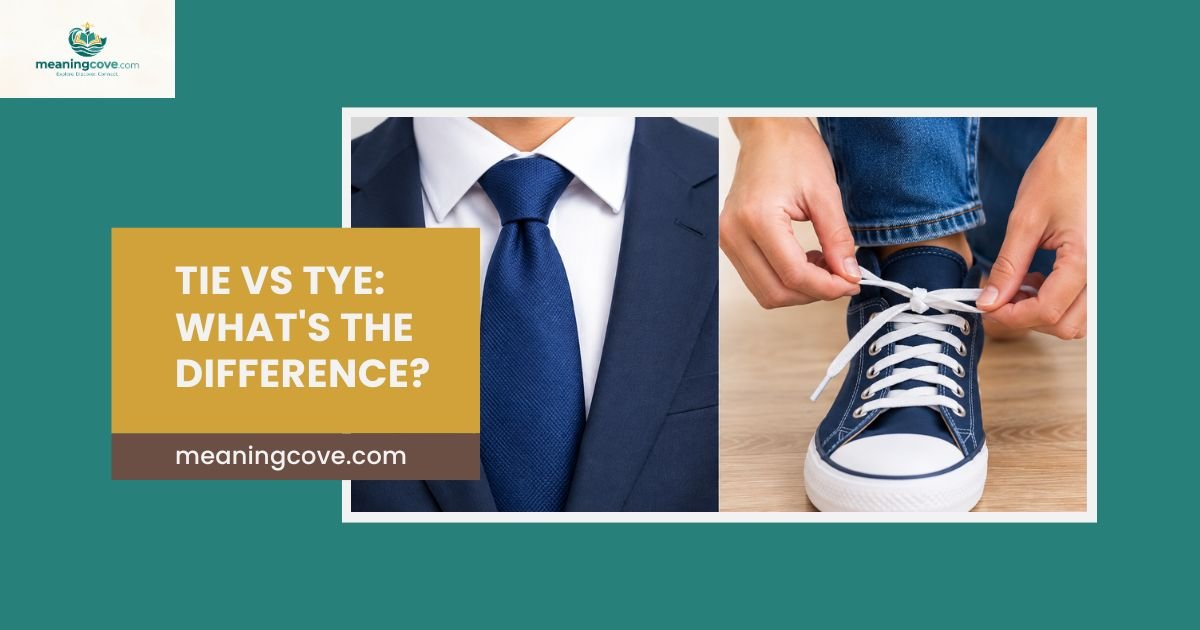
Tie vs Tye: The Ultimate Difference, Meaning & Correct Spelling
Have you ever found yourself questioning your choice between “tie” vs. “tye” mid-sentence? You’re not alone; this common dilemma highlights a fascinating quirk of the English language. Words that sound the same often weave complex tales of meaning and usage.
In this article, we’ll explore the striking differences between these two terms, ensuring that you’ll always know which one to use in your writing.
Tie vs Tye: Quick Answer
Tie is the correct word in nearly every modern writing situation.
Tye is a real, dictionary-recognized word, but it’s rare — mostly limited to historical contexts, geographic names, and surnames today.
| Feature | Tie | Tye |
|---|---|---|
| Common modern word | Yes | No |
| Used in daily writing | Frequently | Rarely |
| Functions as a noun | Yes | Yes |
| Functions as a verb | Yes | Generally no |
| Found in business writing | Yes | Almost never |
| Used in sports | Yes | No |
| Historical usage | Yes | Yes |
If you’re talking about a necktie, a tied score, tying your shoes, family connections, or fastening something, you almost certainly want tie.
What Does “Tie” Mean?
“Tie” is one of the more versatile words in English, functioning comfortably as both a noun and a verb — and shifting meaning depending on context.
Tie as a Noun
A piece of clothing. The most familiar meaning refers to a necktie worn with formal attire.
“He wore a navy tie to the interview.”
An equal result. In sports and competitions, a tie happens when both sides finish with the same score.
“The match ended in a tie after overtime.”
A connection or relationship. Figuratively, a tie describes a bond between people, organizations, or countries.
“The two companies strengthened their business ties.”
Tie as a Verb
As a verb, “tie” means to fasten, secure, connect, or bind something.
“Tie your shoelaces before the race.” “She tied the package with string.” “They tied the boat to the dock.”
It can also describe matching an opponent’s score:
“Both teams tied the match in the final minute.”
Common Everyday Uses of Tie
Part of why “tie” rarely causes confusion is that people run into it constantly.
Clothing and fashion: necktie, bow tie, skinny tie, silk tie — often symbolizing formality or professionalism.
Sports and competitions: “The teams played to a tie,” “the score stayed tied until overtime.” Many tournaments even have specific rules for breaking ties.
Relationships and connections, used figuratively: cultural ties, family ties, economic ties, political ties — all describing a bond that links people or groups.
Fastening objects: tie a knot, tie a rope, tie a ribbon, tie a package — the core, literal meaning of securing something.
What Does “Tye” Mean?
Unlike “tie,” “tye” rarely shows up in modern English, and plenty of people assume it’s simply a typo. In reality, it’s a legitimate word with genuine historical roots — it’s just that most people never encounter it outside specialized contexts.
Historical Meaning
Historically, “tye” referred to:
- A common pasture
- A small enclosure
- A village green
- A shared piece of land
The word belonged mostly to older forms of English, back when rural communities relied on shared spaces for grazing animals and community gatherings. As land use and language evolved, the word’s practical, everyday meaning largely faded away.
Tye in Place Names
Though the common noun has mostly disappeared from use, “tye” survives in certain place names — towns, roads, and geographic features that preserve the older term, functioning almost like linguistic fossils.
Tye as a Surname
You’re also likely to encounter “Tye” as a surname, or as part of a business or family name. When used this way, as a proper noun, it has no connection to the modern word “tie” at all.
The History Behind Tie and Tye
Origins of Tie
The modern word “tie” developed from older Germanic roots tied to binding and fastening. Over time, English speakers expanded its meaning well beyond the literal act of securing something, eventually picking up associations with relationships, equal scores, and clothing — which explains why it shows up in so many different contexts today.
Origins of Tye
“Tye” traces back to older English land terminology, centered on shared pasture and communal village spaces. As land ownership and rural life changed over the centuries, the word gradually fell out of everyday use. Like many historical terms, it survives mainly in maps, place names, family names, and old documents — rarely in modern conversation.
Learn the difference between “dought” and “doubt” with simple meanings and examples.
Why People Confuse the Two
They’re homophones. The biggest reason for the mix-up is simple: “tie” and “tye” sound exactly alike. English has hundreds of homophone pairs — think “their” and “there,” or “flour” and “flower” — and identical pronunciation naturally increases the odds of a spelling slip.
Fast typing errors. Quick typing in emails, texts, and social posts makes small slips like this easy to miss.
Exposure to names. Someone familiar with a person named Tye might assume that spelling applies more broadly — but a proper name doesn’t change standard spelling rules for everyday words.
Limited familiarity with the historical meaning. Many writers have simply never encountered “tye” in its original sense, which can leave them unsure whether it’s a valid alternative spelling. In almost every everyday context, it isn’t.
Side-by-Side Comparison
| Category | Tie | Tye |
|---|---|---|
| Meaning | Fasten, connection, equal score | Historical pasture or enclosure |
| Part of speech | Noun and verb | Mainly noun |
| Modern usage | Extremely common | Extremely rare |
| Business writing | Common | Rare |
| Everyday speech | Common | Rare |
| Place names | Occasionally | Commonly |
One word remains central to everyday modern English. The other survives mostly as a historical relic.
Examples of Tie in Everyday English
Clothing:
- He bought a new tie for the wedding.
- The navy tie matched his suit perfectly.
- She gifted him a silk tie for his birthday.
Sports:
- The game ended in a tie.
- Neither team could break the tie in overtime.
- The championship remained tied heading into the final period.
Relationships:
- Strong family ties helped them through a difficult year.
- The two countries maintain close economic ties.
- Community ties often strengthen a neighborhood.
Fastening:
- Tie the rope securely before you start climbing.
- Please tie the ribbon around the box.
- She tied her hair back before heading outside.
A Quick Workplace Example
Imagine a manager sends this message:
“Please tye your visitor badges securely before entering.”
Readers would likely still understand the instruction, but the spelling reads as a clear error — modern English calls for “tie,” not “tye.”
“Please tie your visitor badges securely before entering.”
It’s a single letter, but spelling accuracy still shapes how professional a message feels, and readers often notice small details like this more than we expect.
Common Mistakes to Avoid
Using “tye” for everyday meanings:
- Incorrect: “Tye your shoes.” / “He wore a blue tye.” / “The game ended in a tye.”
- Correct: “Tie your shoes.” / “He wore a blue tie.” / “The game ended in a tie.”
Assuming the two spellings are interchangeable. Some English word pairs really are accepted variants of each other — think “color” and “colour.” “Tie” and “tye” aren’t one of those pairs; they carry genuinely different meanings.
Copying a name’s spelling into everyday words. A person’s name might be spelled “Tye,” but that has no bearing on the correct spelling for the common noun or verb.
“Tye Smith attended the meeting.” / “Please tie the package securely.” — two unrelated uses of similar-looking words.
Memory Trick
The everyday rule: ask yourself whether you’re talking about fastening, clothing, relationships, or an equal score. If the answer is yes, you want “tie.”
A simple visual reminder: think about how often you tie something — shoes, knots, ribbons, scores, relationships. Because the word shows up constantly in daily life, the standard spelling should start to feel automatic.
A historical reminder: think of “tye” as something closer to a museum word — still real, but mostly found in old documents, place names, and family names rather than everyday writing.
Tie vs Tye in Professional Writing
Professional writing depends on clarity and precision, whether you’re drafting a blog post, business report, academic paper, or quick email. In nearly every one of those situations, the word you need is “tie.”
Using “tye” by accident can quietly undercut a message — creating confusion, reducing perceived professionalism, or simply reading as a spelling mistake. A quick proofread is usually enough to catch it before it becomes a problem.
FAQs
Is “tye” a Real Word?
Yes. It’s a legitimate English word with historical roots tied to pasture land and shared village spaces, though it’s rare in modern usage.
Is “tye” just a Misspelling of “tie”?
Not technically — it’s a recognized word in its own right. That said, most people who write “tye” are genuinely trying to type “tie.”
Which Word Should I Use in Professional Writing?
“Tie,” almost without exception, whether you’re writing an email, article, or report.
Conclusion
The distinction between tie and tye is simpler than it first appears. Tie is the standard modern English word — covering fastening, clothing, relationships, and equal scores — and it’s the word you’ll encounter constantly in daily conversation, writing, and professional communication.
Tye, by contrast, survives mainly in historical language, place names, and surnames. It’s a legitimate word, just a genuinely rare one in modern use.
When in doubt, reach for “tie.” Save “tye” for the rare moments you’re discussing historical land terms, place names, or someone’s actual name — and you’ll never mix the two up again.