
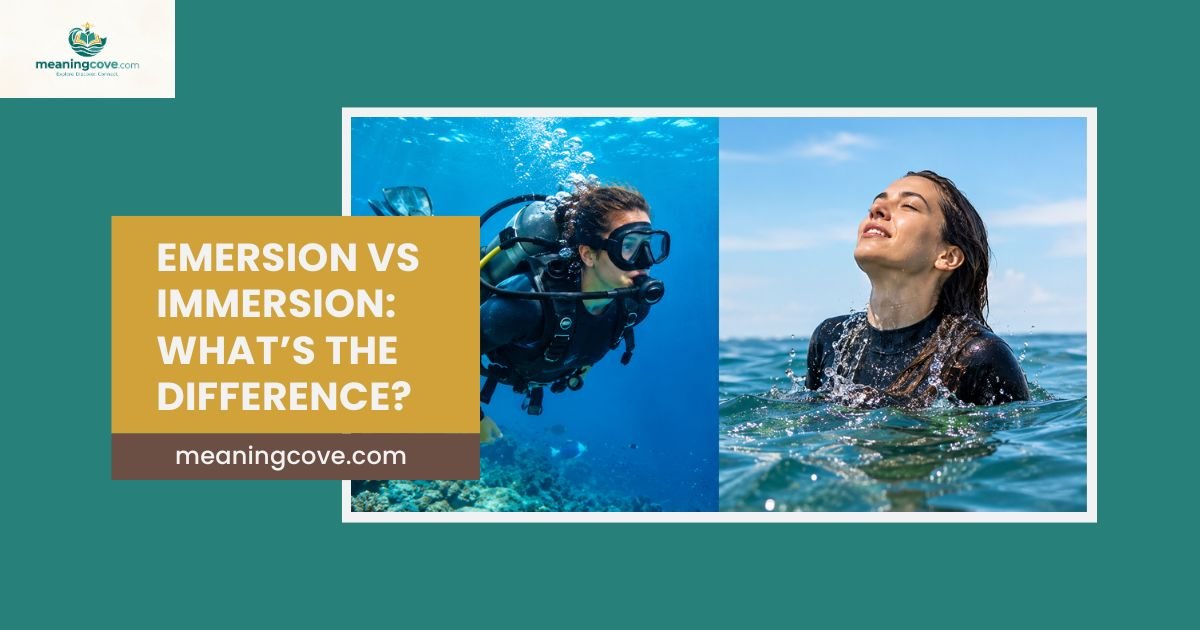
Emersion vs Immersion: What’s the Difference?
The terms emersion and immersion can easily confuse many, and for good reason. They sound similar, and their spellings are closely related, which can lead to mix-ups. However, these two words describe very different or even opposite actions.
Simply put, immersion often relates to going into something, whereas emersion relates to coming out of it. This article will clarify the core distinction between emersion vs immersion, providing definitions, examples, common mistakes, and useful memory tricks.
By the end, you won’t just know what these terms mean; you’ll understand how to use them correctly in everyday contexts.
Emersion vs Immersion: The Quick Difference
To get straight to the point:
- Emersion means coming out or emerging from a substance, usually water.
- Immersion means going into or being surrounded by a substance.
The basic directional difference is that immersion relates to going in while emersion refers to coming out. Among these, immersion is more commonly used in everyday conversation, appearing frequently in contexts like language learning and education.
Comparison Table:
| Feature | Emersion | Immersion |
|---|---|---|
| Basic meaning | Coming out | Going in |
| Direction | Outward | Inward |
| Common contexts | Marine biology, astronomy | Education, gaming, language |
| Everyday usage | Rare | Frequent |
| Example | The diver’s emersion from water | The child’s immersion in a book |
One-Sentence Rule to Remember
To simplify, remember: Immersion = going in / becoming deeply involved; Emersion = coming out / emerging.
What Does Emersion Mean?
Emersion refers to the action of coming out of something, particularly water. It’s a term used less frequently in everyday language, often appearing in more specialized fields.
Definition of Emersion
Emersion is the process of something emerging or becoming visible after being submerged. For example, when the tide goes out, coastal rocks that were underwater become exposed.
Examples:
- A diver’s emersion after surfacing from a dive.
- Plants being exposed during low tide.
- A submarine surfacing after being submerged.
Emersion in Marine Biology
In marine biology, emersion describes how organisms or objects become exposed as water levels drop. For instance:
- Marine organisms: At low tide, many sea creatures are exposed and can be found on the beach.
- Coastal plants: Sea grasses may become visible when the tide recedes.
- Rocks: These become visible as water levels drop, revealing their structure.
Why Emersion Matters
Understanding periods of emersion is crucial for ecological studies. Factors such as exposure to air, light, and temperature can significantly influence organisms’ survival and behavior.
Emersion in Diving
In diving, emersion can describe the action of a diver coming out of the water. For instance, when a diver surfaces, they experience emersion, signaling the end of their underwater adventure.
Emersion in Astronomy
In astronomy, emersion describes the moment an object, like a moon or planet, reappears after being hidden or obscured during an event like an eclipse.
Emersion Example Sentences
- The emersion of the sun after the storm brought warmth back to the chilly beach.
- Here, “emersion” is used to describe the sun coming out after being obscured by clouds.
- Many sea creatures depend on the emersion at low tide for feeding.
- In this context, emersion highlights the exposure of organisms due to receding water levels.
- The divers enjoyed a smooth emersion from their deep dive into the ocean.
- “Emersion” here correctly refers to the diver surfacing from the water.
- The plant’s emersion from the water was vital for its photosynthesis process.
- This shows how emersion facilitates crucial life functions for plants.
- Astronomers noted the emersion of the satellite as it passed behind the planet.
- Here, “emersion” denotes the satellite becoming visible again after an interval of being hidden.
- The emersion of a diver indicates they’re ready to share their underwater experiences.
- In this instance, “emersion” describes leaving the water and returning to the surface.
- The emersion of coastal wildlife is a fascinating event for nature enthusiasts.
- This highlights the emerging wildlife observable during certain tide conditions.
- Seasonal emersions in wetlands can affect fish survival rates.
- This example correctly uses “emersion” to describe the seasonal exposure of aquatic environments.
Common Mistakes With Emersion
Mistake 1 – Using Emersion Instead of Immersion
Incorrect: She found herself in a state of emersion in her new culture.
Correct: She found herself in a state of immersion in her new culture.
“Immersion” is correct here because it describes deeply engaging with the culture, while “emersion” would imply coming out of it.
Mistake 2 – Confusing Emersion With Emergence
While emersion involves coming out of something, emergence refers to the process of becoming visible. For example, The emergence of new ideas can shape a project versus The emersion of the tide revealed hidden rocks clarifies their distinct meanings.
Mistake 3 – Using Emersion for Deep Involvement
Actions such as language learning or gaming typically employ the term immersion. You wouldn’t say, The emersion in the game led to better skills. It should be The immersion in the game led to better skills.
What Does Immersion Mean?
Immersion implies being enveloped or completely surrounded by something. It can refer to physical submersion in water or metaphorically involve deep engagement in various activities, such as education or language learning.
Definition of Immersion
Immersion relates to the act of deeply engaging or surrounding oneself in a given environment. For example, when a student studies in another country, they experience immersion in that culture.
Immersion in Language Learning
In language learning, immersion means constant exposure to the target language as students engage with native speakers, enhancing their communication skills through practical experiences. For instance:
- Living with a host family provides real-world language practice.
- Attending cultural events helps understanding of colloquial expressions.
- Participating in local activities accelerates language comprehension.
- Using media in the target language daily reinforces learning.
- Engaging in conversation with locals enriches vocabulary and fluency.
Characteristics of Language Immersion
- Daily exposure to the target language
- Regular conversations with native speakers
- Authentic reading and listening materials
- Practical communication experience
- Cultural interactions through events and gatherings
Immersion in Education
In educational contexts, immersion signifies learning environments where students actively engage with the subject matter. Examples include:
- Simulations that mimic real-world scenarios
- Projects that require research and collaboration
- Experiments that encourage scientific inquiry
- Interactive activities that foster engagement
- Virtual experiences that create realistic learning environments
Immersion in Virtual Reality
In the realm of virtual reality, immersion describes the user’s experience of being surrounded by an interactive, realistic environment. Features include:
- Presence in a 3D virtual world
- Interactive elements that enhance user connection
- Visual realism that resembles real-life settings
- Spatial audio that mimics realistic sound environments
- Motion tracking that allows physical movement within the space
Immersion in Gaming
Gamers frequently use the term immersion to express the deep connection to game worlds. For example:
- Compelling storytelling captivates players’ emotions.
- Realistic soundscapes enhance the gaming experience.
- Engaging character interactions draw players into the narrative.
- Player choices create emotional investment in outcomes.
Immersion in Everyday Life
Overall, immersion can characterize involvement in daily activities, art, travel, and any experience requiring focus. For illustration:
- Reading a gripping novel engulfs the reader completely.
- A hobbyist painting for hours loses track of time.
- A traveler immerses themselves in local traditions while visiting.
- Creative activities — like writing or crafting — often demand full attention.
Immersion Example Sentences
- She enjoys complete immersion in her favorite novels, losing track of time.
- This sentence highlights deep engagement with the activity of reading.
- His immersion in language classes helped him become fluent quickly.
- Here, “immersion” pertains to his total involvement in learning languages.
- The team’s immersion into the project made a significant impact on its success.
- This shows balanced engagement with a group effort to produce excellent results.
- The immersion offered by the VR experience transported users to another world.
- In this context, immersion indicates how users were enveloped in virtual reality.
- Their cultural immersion allowed them to grasp the nuances of the language.
- This example demonstrates engagement in learning through cultural practices.
- Immersion in nature can have a therapeutic effect on mental well-being.
- Here, immersion refers to deep experiences in a natural environment.
- He achieved immersion in art by spending hours at the gallery.
- This highlights dedication to appreciating art forms deeply.
- The language school uses immersion techniques to enhance learning efficiency.
- This sentence showcases a common educational strategy to improve language skills.
Learn the difference between “dought” and “doubt” with simple examples.
Emersion vs Immersion: Side-by-Side Comparison
| Category | Emersion | Immersion |
|---|---|---|
| Meaning | Coming out | Going in |
| Direction | Outward | Inward |
| Main idea | Emerging | Being surrounded |
| Frequency | Less common | More frequent |
| Common fields | Marine biology, astronomy | Education, gaming, language |
| Water-related meaning | Exposure during low tide | Submersion in water |
| Education | Rare usage | Commonly used |
| Language learning | Not applicable | Key concept |
| Technology | Rarely mentioned | Frequently discussed |
| Example | The emersion of marine life | The immersion in a new culture |
In summary, emersion implies coming out from something, while immersion indicates entering into or becoming surrounded by something. Understanding these nuances is crucial for effective communication.
Why Do People Confuse Emersion and Immersion?
Similar Spellings
The words emersion and immersion differ by only a small part of their spelling, which can lead to mix-ups, especially for those who might not use them frequently.
Similar Pronunciation Patterns
Their similar phonetic sounds can create confusion, leading people to inadvertently swap them when speaking or writing, especially in casual settings.
Related Concepts
Both terms involve some interaction with an environment, contributing to confusion. For instance, whether diving into water or coming out of it are related actions that overlap conceptually.
Limited Exposure to Emersion
Readers encounter immersion much more often than emersion, so when they see or hear emersion, they may not have a clear context to differentiate the two.
Emersion, Immersion, and Emergence: What’s the Difference?
| Word | Basic Meaning | Example Context |
|---|---|---|
| Emersion | Coming out or being exposed after submersion | A diver’s emersion after a dive. |
| Immersion | Going in or being completely involved | Students experiencing immersion in language. |
| Emergence | Becoming visible or apparent | The emergence of a butterfly from its chrysalis. |
Emersion
“Emersion” implies becoming visible after being submerged, as in marine biology or astronomy.
Immersion
“Immersion” describes deep involvement in a subject or activity, such as in education or language learning.
Emergence
“Emergence” signifies becoming known or visible, such as ideas or organisms coming into view.
Real-World Examples That Make the Difference Easy to Remember
The Diver Example
- Immersion: A diver descending into the ocean.
- Emersion: That same diver surfacing after their dive.
The Submarine Example
- Immersion: A submarine diving beneath the water’s surface.
- Emersion: The same submarine surfacing to reveal itself above water.
The Tide Pool Example
- Immersion: High tide where marine life is underwater.
- Emersion: When water recedes, exposing rocky tide pools.
The Language School Example
- Students experience language immersion when learning abroad, developing fluency through cultural interaction, collaboration, and real-life communication.
- Participating in discussions with classmates magnifies the immersion experience.
- Reading and writing in everyday situations facilitate deeper learning.
- Exploring historical sites often leads to engaging conversations in the target language.
The Virtual Reality Example
- In VR, immersion offers total engagement within a game, creating a convincing experience that allows players to feel “inside” the game world.
Which Word Should You Use?
Use Emersion When:
- Describing something emerging from water.
- Referring to scientific phenomena regarding exposure.
- Discussing astronomical events when objects become visible again.
- Talking about marine life or ecological studies that involve exposure.
Use Immersion When:
- Discussing language learning and practices.
- Referring to educational experiences that engage students fully.
- Talking about gaming and virtual reality experiences.
- Describing moments of concentrated focus or deep engagement in hobbies.
Quick Decision Guide
Is something going in or becoming deeply involved? → Immersion
Is something coming out or becoming exposed? → Emersion
Memory Tricks to Never Confuse Them Again
Immersion = In
Relate the initial part of “immersion” (imm-) to the concept of going in.
Emersion = Exit
Think of “emersion” as out, highlighting the ‘em’ sound corresponding to exiting or emerging.
The Pool Trick
Visualize two scenarios:
- Jumping into a pool = immersion (entering).
- Climbing out of a pool = emersion (exiting).
The Direction Test
Ask yourself:
- Going in? → Immersion
- Coming out? → Emersion
Key Takeaways
- Emersion means coming out or becoming exposed after being submerged.
- Immersion refers to going in or being deeply involved in an activity or environment.
- The primary directional difference is going in for immersion and coming out for emersion.
- Immersion is more common in everyday language, especially in education and language contexts, while emersion is more specialized.
- Emergence is a related term indicating becoming visible or known, but it has its own distinct meaning.
- Memory tricks can help reinforce the differences and ensure correct usage.
Frequently Asked Questions
What is the Main Difference Between Emersion and Immersion?
The main difference is directional; immersion involves going into something, while emersion is about coming out or becoming visible after being submerged.
In What Contexts Would I use Emersion?
Use emersion in contexts involving physical or ecological exposure, such as marine biology when organisms are exposed at low tide or in astronomy when celestial bodies reappear.
Can you Give an Example of Immersion in Education?
Sure! An example of immersion in education might be a student studying abroad in a country where the target language is spoken, allowing for daily integration and practice.
Why do People Often Confuse These two Words?
People often confuse these words because they sound similar, have closely related spellings, and both involve interactions with environments, leading to potential mix-ups.