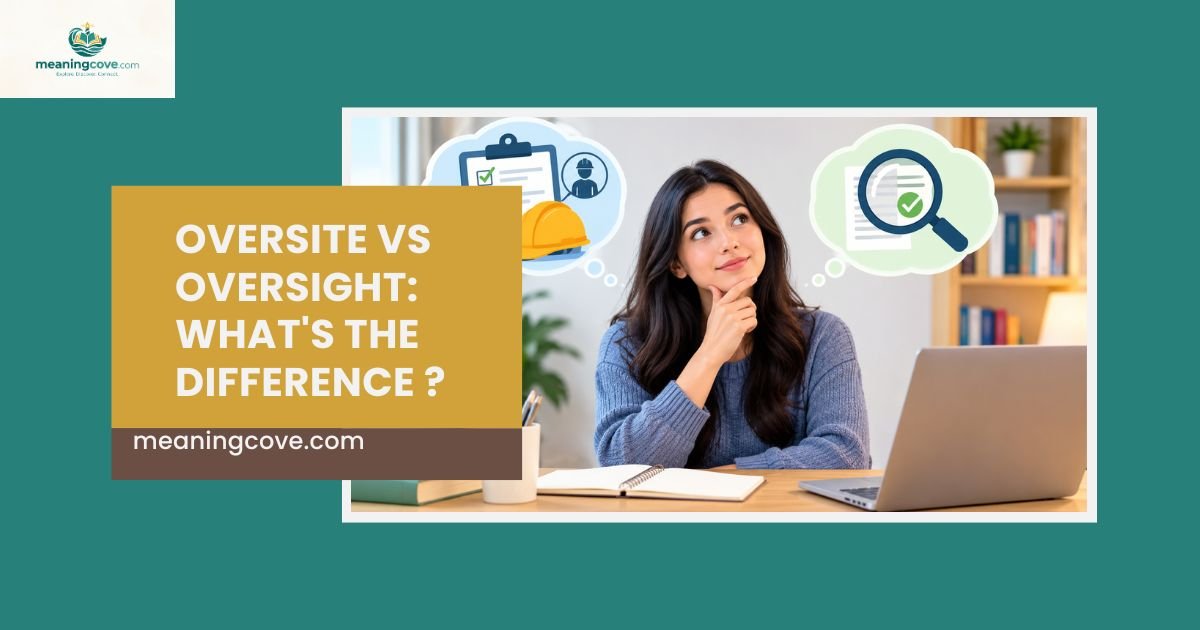
Oversite vs Oversight: What’s the Difference and Which Word Should You Use?
Small spelling mistakes can quietly undermine writing that’s otherwise clear and well-organized. One mix-up that shows up constantly, even among experienced writers, is the confusion between oversite vs oversight.
The two words look almost identical on the page and sound similar when spoken quickly. But only one of them is standard English, and using the wrong one in a business report, email, or article can quietly chip away at how credible your writing seems.
This guide breaks down exactly what oversight means, why people mistakenly type “oversite,” when (if ever) oversite is acceptable, and how to remember the difference for good.
What Does Oversight Mean?
Oversight is a standard English noun with two genuinely different meanings, depending on context — which is part of why it trips people up.
| Meaning | Explanation |
|---|---|
| Supervision | Actively watching over or managing something |
| Mistake | Failing to notice or account for something |
Example:
“The committee provides financial oversight.” (supervision) “Leaving her name off the list was an oversight.” (mistake)
Same word, two nearly opposite implications. Context is what tells you which one applies.
Oversight as Supervision
In professional and institutional settings, oversight most often refers to monitoring, management, or supervisory responsibility. You’ll see it constantly in:
- Government and regulatory contexts
- Corporate governance
- Legal and compliance work
- Healthcare administration
- Project and construction management
Examples:
- The finance committee maintains oversight of the annual budget.
- Regulatory bodies provide oversight of pharmaceutical testing.
- The project lead was responsible for oversight across all phases.
In each case, oversight signals active supervision rather than a mistake.
Why Organizations Rely on Oversight
Without proper oversight, organizations run real risks — financial losses, legal exposure, compliance failures, and reputational damage among them. That’s why structured oversight shows up across so many functions:
| Type of Oversight | Purpose |
|---|---|
| Financial oversight | Preventing fraud and error |
| Regulatory oversight | Ensuring legal compliance |
| Executive oversight | Guiding overall strategy |
| Safety oversight | Reducing accidents and risk |
| IT oversight | Protecting systems and data |
Oversight as a Mistake
The second meaning is almost the opposite: an accidental omission or a failure to notice something.
Examples:
- Forgetting to attach a required document
- Missing a deadline by mistake
- Leaving an error uncorrected in a report
- Sending a message to the wrong person
In sentences:
- “The missing signature was simply an oversight.”
- “The scheduling conflict happened due to an oversight on our part.”
This usage tends to carry a softer tone than words like “blunder” or “negligence,” which is exactly why it’s often used diplomatically. Saying “there seems to have been an oversight” acknowledges a mistake without sounding accusatory.
Is Oversite a Real Word?
In short: no, not in standard English. “Oversite” is almost always a misspelling of “oversight,” and most dictionaries don’t recognize it as a legitimate word.
That means in business writing, academic work, legal documents, or professional emails, “oversite” will nearly always read as an error.
Why People Type Oversite Instead
A few reasons explain why this mistake happens so often:
- The two words sound similar in fast speech
- People type quickly and don’t always double-check
- Spell-checkers sometimes miss it, since “site” is a valid word on its own
- “Site” appears constantly online (website, job site, construction site), making it visually familiar
The brain essentially swaps the ending “-sight” for the more commonly seen “-site,” since both are frequent word endings.
Rare Exceptions
There are a few edge cases where “Oversite” legitimately appears — usually as a stylized brand name, a domain name, or a proprietary term coined by a company (particularly in tech or construction). Outside of intentional branding like that, though, “oversight” remains the correct choice essentially every time.
Oversite vs Oversight: The Core Difference
| Term | Meaning | Standard English? | Common Usage |
|---|---|---|---|
| Oversight | Supervision or accidental mistake | Yes | Very common |
| Oversite | Almost always a spelling error | No | Rare, mostly typos or branding |
If you’re writing professionally, oversight is the word you want. Using “oversite” by accident can quietly suggest weaker proofreading or attention to detail — a small error that can carry an outsized impact on how your writing is perceived.
Why the Confusion Happens
Human brains tend to process familiar-looking words by pattern recognition rather than letter-by-letter analysis, which is part of why even careful writers slip up here.
Similar sound. Spoken quickly, “oversight” and “oversite” can sound nearly identical.
Constant exposure to “site.” Between websites, job sites, and construction sites, “site” is one of the most visually familiar word endings online.
Typing speed. Fingers often move faster than the brain double-checks spelling.
Imperfect autocorrect. Since “site” is a real word, spell-checkers don’t always flag “oversite” as an error.
Difference between “stuck” and “stock” explained simply.
Oversight in Real-World Contexts
In Business
Corporate settings use the term constantly — financial oversight, executive oversight, compliance oversight, and operational oversight are all common phrases. Public companies frequently establish oversight committees responsible for auditing finances, monitoring leadership decisions, and reviewing legal compliance.
In Government and Law
Government systems depend heavily on oversight to keep power accountable. Congressional oversight, judicial oversight, and regulatory oversight all serve to check institutional behavior and reduce the risk of misconduct going unnoticed.
In Healthcare
Hospitals rely on oversight procedures to protect patient safety, medication accuracy, and treatment standards. An oversight committee might review infection rates, staff compliance, or emergency response performance — the stakes here are genuinely high.
In Technology and AI
The rise of artificial intelligence has put “human oversight” at the center of a lot of tech conversations. Because AI systems can produce biased, inaccurate, or unsafe outputs, many organizations now require human review before automated content, hiring decisions, or recommendations go live.
In Construction and Engineering
Construction projects involve significant safety and financial risk, which is why oversight covers everything from safety inspections and budget monitoring to code compliance and quality checks. A single oversight failure on a job site can have serious downstream consequences.
Common Sentence Examples
Professional:
- The board exercised oversight throughout the merger process.
- Regulatory oversight increased significantly following the investigation.
Everyday:
- Missing your call earlier was a genuine oversight on my part.
- I apologize for the oversight in yesterday’s report.
Technology:
- AI systems still require meaningful human oversight.
- Ethical oversight remains a major topic in machine learning research.
Incorrect vs correct:
| Incorrect | Correct |
|---|---|
| The agency handled oversite of the project. | The agency handled oversight of the project. |
| Financial oversite is important. | Financial oversight is important. |
| The mistake was an oversite. | The mistake was an oversight. |
Oversight Synonyms and Alternatives
Repeating the same word too often weakens writing, so it helps to have alternatives on hand.
Synonyms for oversight (supervision):
| Word | Best Use Case |
|---|---|
| Supervision | General monitoring |
| Governance | Corporate or institutional contexts |
| Monitoring | Ongoing observation |
| Administration | Organizational management |
| Regulation | Legal or compliance-focused oversight |
Synonyms for oversight (mistake):
| Word | Tone |
|---|---|
| Error | Neutral |
| Omission | Formal |
| Slip | Casual |
| Lapse | Temporary failure |
| Neglect | Stronger, more negative |
Grammar Notes
Oversight is a noun in both of its meanings.
- “Oversight is necessary at every stage.”
- “The oversight caused a significant delay.”
Singular and plural:
| Form | Example |
|---|---|
| Oversight | One instance of supervision or one mistake |
| Oversights | Multiple mistakes or supervisory roles |
Example:
Several small oversights appeared during the final review.
How to Remember the Difference
The “sight” trick: Oversight involves watching, seeing, and noticing — think of the word “sight” hidden inside it. That connection makes the correct spelling much easier to recall.
| Word Part | Meaning Connection |
|---|---|
| Sight | Vision, observation, noticing |
| Oversight | Watching over, or missing something visible |
Once you make that link, the spelling starts to feel logical rather than arbitrary.
A few practical habits that help:
- Read important documents slowly before sending them
- Use a grammar checker, but don’t rely on it entirely
- Read text aloud — awkward spelling often stands out more when spoken
- Do a quick search for “oversite” in long documents before publishing
Why Accurate Word Choice Matters
Spelling mistakes might seem minor, but they can quietly shape how readers judge your credibility. Research on reader perception consistently shows that small errors reduce how trustworthy and competent writing appears — even when the actual content is solid.
Picture two nearly identical business proposals, one that says “we provide strategic oversight” and one that says “we provide strategic oversite.” The first reads as polished and professional. The second raises a small, unnecessary doubt. That gap, however small it seems, can genuinely influence how a reader responds.
FAQs
Is “oversite” ever Correct?
Rarely. It’s almost always a misspelling of “oversight.” The only real exceptions are intentional brand names or proprietary terms, not standard usage.
Why do People Confuse Oversite and Oversight?
The words sound alike when spoken quickly, and “site” is such a familiar word online that it’s easy for the brain to substitute it in by mistake.
What does Oversight Actually Mean?
It has two meanings — supervision or monitoring, and an accidental mistake or omission. Context determines which one applies.
Is Oversight a Positive or Negative Word?
It depends on the meaning in play. As supervision, it’s generally positive. As a mistake, it carries a more negative connotation.
Can Oversight Mean Both Supervision and Mistake at once?
Technically, yes, since it’s the same word — but context almost always makes clear which meaning is intended in a given sentence.
Should Businesses Avoid Using “oversite”?
Yes, unless it’s part of an official brand or product name. Otherwise, “oversight” is the correct and expected term in professional writing.Yes, unless it’s part of an official brand or product name. Otherwise, “oversight” is the correct and expected term in professional writing.
Conclusion
The difference between oversite and oversight comes down to a single letter, but it carries real weight in professional writing. Oversight is the correct standard English word, capable of meaning either careful supervision or an accidental mistake depending on context. Oversite, outside of rare branding cases, is simply a common misspelling.
Getting this one right is a small thing — but small things add up, and using the correct word signals the kind of attention to detail that readers notice, even if only subconsciously.