
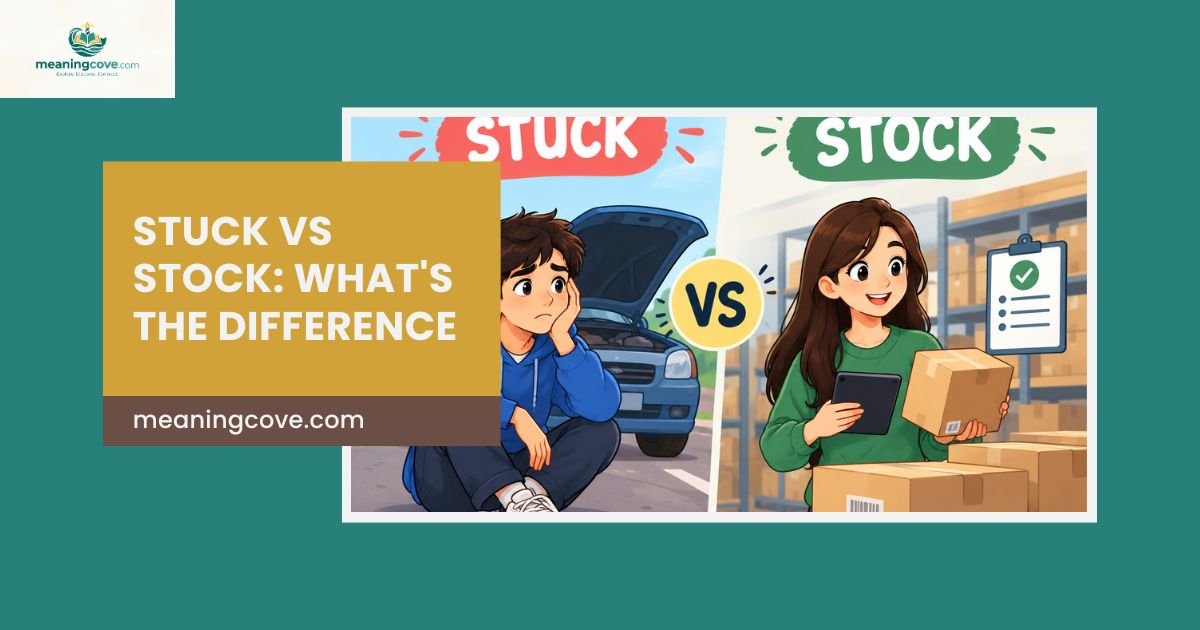
Stuck vs Stock: What’s the Difference
Few word pairs trip up English learners and even native speakers quite like stuck and stock. They look similar on the page, share the same starting and ending letters, and both show up constantly in everyday conversation — which makes it surprisingly easy to type one when you mean the other.
But despite their visual similarity, stuck and stock mean completely different things. Stuck describes something that can’t move, progress, or escape a situation. Stock refers to a supply of goods, items kept for future use, or even shares owned in a company. Mixing them up doesn’t just sound like a small typo — it can genuinely confuse the meaning of a sentence.
This guide breaks down exactly how these two words differ, why the confusion happens so easily, and how to choose the right one every time — in speech, writing, business communication, and everyday conversation.
Why “Stuck vs Stock” Confusion Happens So Easily
This mix-up isn’t random. A few clear patterns explain why so many people type or say the wrong word.
They Look Almost Identical
Both words begin with “st,” end with “ck,” and are exactly five letters long. Visually, they sit close enough together that your brain can easily swap one for the other, especially when reading or typing quickly.
Typing Speed Plays a Role
Most mix-ups happen in fast-paced writing — emails, chat messages, or notes typed under time pressure. Your fingers sometimes land on the more familiar pattern instead of the intended word.
Spell-Check Won’t Catch It
Since both “stuck” and “stock” are real, correctly spelled words, spell-checkers and autocorrect tools have no way of knowing you meant the other one. The error slips through silently, even in otherwise polished writing.
Pronunciation of Stuck vs Stock
Even though the words are spelled similarly, they don’t sound alike once you say them out loud.
Stuck
- Pronounced: /stʌk/
- Rhymes with “luck” or “truck”
- Short, tight “uh” vowel sound
Stock
- Pronounced: /stɒk/
- Rhymes with “lock” or “rock”
- Slightly wider “ah” or “o” vowel sound
A simple trick: say both words slowly and notice how your mouth opens a bit more for “stock” than it does for “stuck.” That small difference in sound reflects a completely different meaning.
What Does “Stuck” Mean?
At its core, stuck describes something that is unable to move, change, or get past a difficulty. It’s the past tense of the verb “stick,” which originally meant to become fixed or attached to something.
Stuck typically shows up in three main contexts:
Physical Situations
- “The elevator is stuck between floors.”
- “My shoe got stuck in the mud.”
Mental Blocks
- “I’m stuck on question three.”
- “He’s stuck trying to figure out the ending of his story.”
Emotional or Life Situations
- “She feels stuck in her current job.”
- “They’ve been stuck in the same routine for years.”
The simplest way to remember it: if something isn’t moving forward, “stuck” is almost always the right word.
What Does “Stock” Mean?
Unlike “stuck,” the word stock carries several different meanings depending on the context, which is exactly why it can be trickier to use correctly.
Supply or Inventory
This is the most common everyday use — referring to goods or items kept on hand.
- “The bakery is low on stock this week.”
- “We need to reorder before we run out of stock.”
Financial Ownership
Stock also refers to a share of ownership in a company.
- “He invested in stock from a renewable energy company.”
- “The stock market had a volatile week.”
Business and Logistics Terms
- “New stock arrives every Monday.”
- “The warehouse needs to be restocked by Friday.”
The simplest way to remember it: if the sentence involves supply, inventory, or company shares, “stock” is the word you need.
Side-by-Side Comparison
| Feature | Stuck | Stock |
|---|---|---|
| Core meaning | No movement or progress | Supply, inventory, or ownership |
| Word category | Verb (past tense) | Noun or verb |
| Common field | Everyday situations, emotions | Business, finance, retail |
| Example | “I’m stuck in traffic.” | “The store has plenty of stock.” |
| Mental image | Trapped, jammed, blocked | Shelves, warehouse, shares |
Stuck vs Stock in Everyday Communication
Seeing both words used in real, familiar situations makes the difference click much faster.
At Work
- “I’m stuck waiting on approval before I can move forward.”
- “We’re checking our stock levels before the holiday rush.”
At School
- “I got stuck on the last question of the exam.”
- “The chemistry lab keeps a stock of basic supplies.”
At Home
- “The zipper on my jacket is stuck.”
- “We should stock up on groceries before the storm.”
Why “Stock” Has More Meanings Than “Stuck”
This isn’t just a coincidence — it comes down to how each word developed over time.
Stuck Stayed Narrow
“Stuck” has consistently centered on one core idea: something fixed in place or unable to move, whether that’s physical, mental, or emotional.
Stock Expanded Over Time
“Stock” branched out into multiple industries and uses, including trade, finance, supply chains, and everyday phrases like “in stock” or “out of stock.” That range is exactly why stock feels more flexible than stuck, even though both are common, everyday words.
Common Mistakes with Stuck vs Stock
Even confident English speakers slip up occasionally, especially when writing quickly.
Typical errors:
- “I’m stock in traffic.” ❌ (should be “stuck”)
- “We’re low on stuck.” ❌ (should be “stock”)
- “The page is stock loading.” ❌ (should be “stuck”)
These mistakes usually happen because your brain is already thinking ahead to the next word in the sentence, and the wrong — but similarly spelled — word slips out first.
How to Choose the Right Word Every Time
A simple two-question filter clears up almost every situation:
- Am I describing something that can’t move or progress? → Use stuck.
- Am I describing supply, inventory, or ownership? → Use stock.
Quick mental shortcut:
- Stuck = “I can’t move forward.”
- Stock = “I have something stored or owned.”
This filter works correctly in the overwhelming majority of everyday sentences.
Memory Tricks to Never Confuse Them Again
Trick 1: Picture the Scene
Stuck = mud, traffic, a jammed door Stock = shelves, warehouses, a stock market chart
Trick 2: Expand the Word Mentally
Stuck → “stuck in place” Stock → “a stock of supplies”
Trick 3: Attach an Emotion
Stuck tends to feel frustrating or limiting. Stock tends to feel organized, structured, or financial.
Since emotional associations are often easier to recall than grammar rules, this trick can be surprisingly effective under pressure.
Learn more about other ways to say “Have a Good Rest of Your Day” with simple examples.
Real-World Examples of the Mix-Up
Workplace Email
An employee types: “We are stock behind schedule on this project.”
The intended sentence was: “We are stuck behind schedule on this project.” The wrong word changes the tone from a supply issue to what looks like a typo that can undercut the message’s clarity.
Retail Signage
A store posts: “We are stuck of winter coats.”
The correct version should read: “We are out of stock of winter coats.” Here, the error directly affects how clearly customers understand the message.
Classroom Writing
A student writes: “The company has stuck trading on the exchange.”
The intended meaning was: “The company has stock trading on the exchange.” A single swapped word completely changes the meaning of the sentence.
Where These Words Come From
Stuck
“Stuck” traces back to the Old English word stician, meaning to pierce or remain fixed in place. Over time, this evolved into the modern verb “stick,” with “stuck” becoming its past tense form.
Stock
“Stock” comes from the Old English word stocc, originally meaning a tree trunk or log. Over centuries, the meaning expanded to represent stored goods, and eventually, financial shares in a company.
It’s a neat contrast: one word stayed rooted in the idea of being fixed in place, while the other grew to represent stored value and ownership.
Quick Practice Exercise
Choose the correct word for each sentence:
- The truck got ___ in the mud after the storm.
- She bought ___ in a well-known tech company.
- I feel completely ___ on this puzzle.
- The store just received new ___ for the season.
Answers: 1. stuck 2. stock 3. stuck 4. stock
FAQs
Can “stuck” ever Refer to Money or Finances?
No. Stuck always relates to being unable to move, progress, or escape a situation — it has no financial meaning.
Can “Stock” be Used to Describe Emotions?
Not typically. Stock stays tied to supply, inventory, or ownership, while emotional states are expressed with words like “stuck.”
Are Stuck and Stock ever Interchangeable?
No, they are never interchangeable. Swapping one for the other changes the meaning of the sentence entirely.
Which Word Should I use for “we Don’t Have any Left”?
That situation calls for stock — as in “we’re out of stock” — since it refers to supply or inventory.
Which Word fits a Frustrating Situation, like Being Unable to solve a Problem?
That calls for stuck, since it describes being unable to move forward or make progress.
Conclusion
Once you see stuck and stock side by side, the difference becomes easy to remember. Stuck always points to a lack of movement or progress — physically, mentally, or emotionally. Stock always points to supply, storage, or ownership, whether that’s a warehouse full of products or shares in a company.
The next time you’re unsure which one to use, ask yourself a simple question: is this about being unable to move forward, or is it about something stored or owned? That one distinction will guide you to the right word almost every time.